
August 10, 2026 · Umer Jamil
Denial management is a data problem before it is a staffing problem
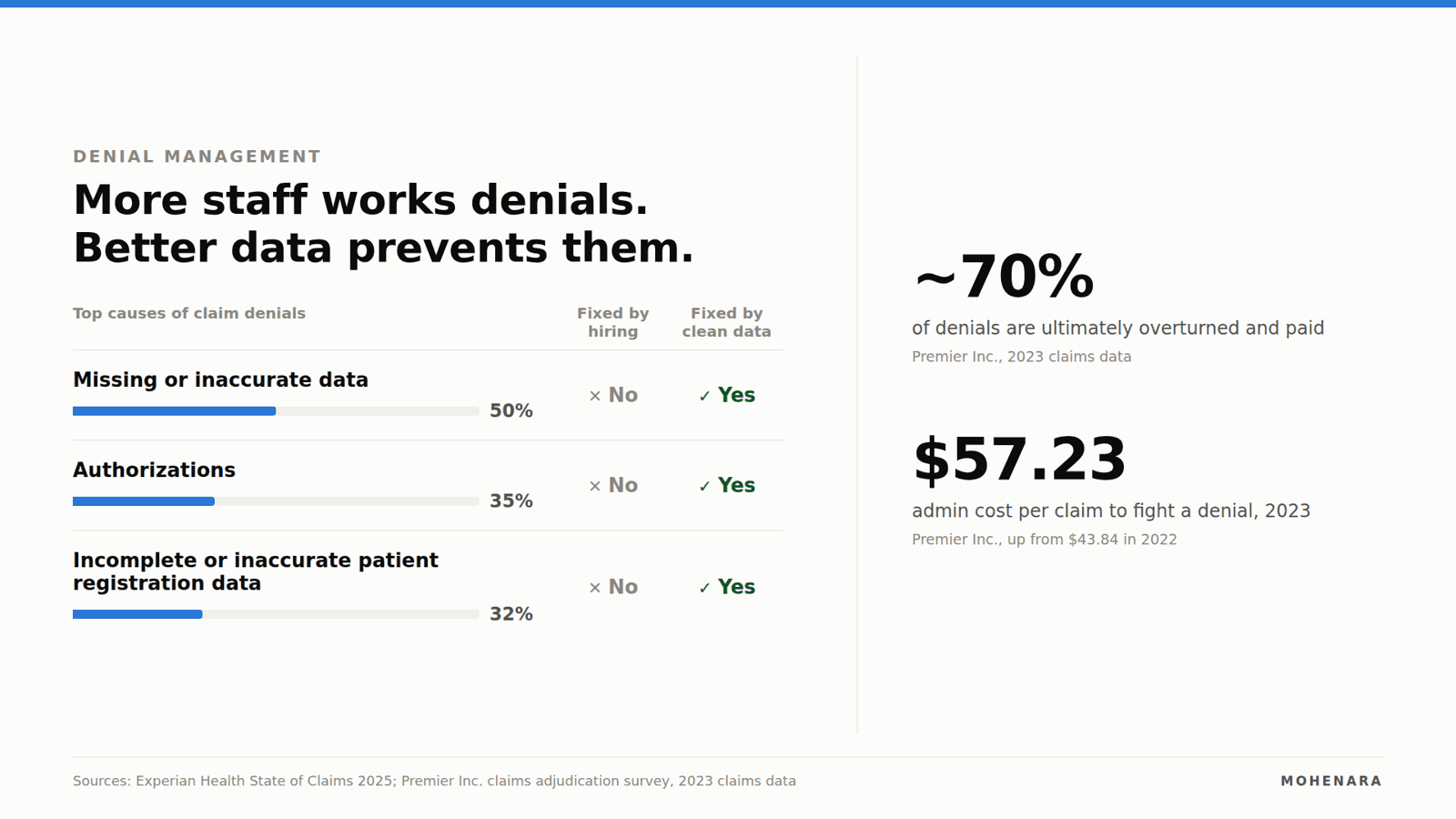
Two numbers describe the state of claim denials better than any pitch deck. About 70% of denials that providers fight are ultimately overturned and paid, according to Premier Inc.'s national survey of hospital claims. And the administrative cost of each of those fights reached $57.23 per claim in 2023, up from $43.84 the year before.
Read those together and the conclusion writes itself. The information needed to pay the claim existed. The payer ended up agreeing. The only thing the fight produced was cost.
The hiring reflex
When denials pile up, the standard response is to add people. More AR callers, more appeals writers, more follow-up staff. It feels productive because it is productive, in one narrow sense: the backlog gets worked faster.
The denial rate stays where it was. Every appeal handles a claim that has already failed. None of that labor reaches the next claim before it goes out the door.
That distinction matters more every year. In Experian Health's 2025 State of Claims survey, 54% of providers said denials are still increasing, and 41% reported that at least one in ten claims gets denied.
Where denials actually come from
The same Experian survey asked 250 revenue cycle decision makers to name the top causes of their denials. The answers, in order: missing or inaccurate data (50%), authorizations (35%), and incomplete or inaccurate patient registration data (32%).
All three are data failures. A wrong subscriber ID, a lapsed eligibility check, an authorization that was never obtained or never attached, a registration record with a transposed date of birth. Each one is decided before the claim is submitted, which means each one is decided before any appeals team can touch it.
An appeals team can win the argument afterward. It cannot prevent the argument.
The price of being right late
Premier's claims adjudication research puts a national figure on that afterward. Providers spent $25.7 billion in 2023 contesting denied claims, and Premier estimates nearly $18 billion of that was spent on claims that should have been paid at first submission.
This is the money the industry spends being right late. The overturn rate proves the claims were payable. The $57.23 per claim measures what it costs to prove it one claim at a time, after the fact, with human labor.
Headcount scales that cost linearly. Ten times the appeal volume needs roughly ten times the appeals labor, at $57.23 a fight, forever. Clean data works on the other side of the submission: it removes the fight entirely, and the cost of preventing an error does not grow with the number of times the error would have recurred.
The order of operations
None of this means appeals teams are the problem. Billing teams are winning most of what they contest, which is exactly what competence looks like under these conditions. The problem is the position they are forced to fight from.
The fix has an order. First, treat every denial as a data point rather than a work item: capture the reason codes, tie them back to the field, the process, or the payer rule that produced them, and fix the source. Eligibility verification at scheduling, authorization capture before service, registration quality checks, payer-specific edits before submission. Then staff for whatever volume survives that.
Run it in the other order and the team grows every year while the denial rate holds. Run it in this order and the staffing problem shrinks on its own, because the work it was hired for stops arriving.
Denial management is a data problem before it is a staffing problem. The 70% overturn rate is the proof, and the $57.23 per claim is the bill for solving it in the wrong order.
Sources: Experian Health, State of Claims 2025 (survey of 250 healthcare professionals responsible for financial, billing, or claims management decisions); Premier Inc., claims adjudication survey (280 hospitals across 23 states, claims from January 1 to December 31, 2023).