
August 11, 2026 · Umer Jamil
The denial spike was scheduled
On December 31, a pair of procedure codes paid clean. On January 1, the same pair hit an edit and denied. Nothing about the claim changed. The table it was judged against did.
That table is the National Correct Coding Initiative's procedure-to-procedure edit file, and on January 1, 2026, CMS put version 32.0 of it into effect under Transmittal 13410 (Change Request 14224). If you run a billing company and your bundling denials spiked in Q1, there's a decent chance this document is the reason, and there's a decent chance nobody in your building has read it.
What the table actually is
NCCI PTP edits exist to stop procedure pairs from being paid together when CMS believes they shouldn't be. Every claim you submit to Medicare gets checked against this table, and most commercial payers run their own versions of the same logic.
The scale is worth sitting with. The practitioner edit set alone spans four files, each carrying between roughly 608,000 and 675,000 records, which puts the full practitioner set above 2.4 million edit records. The hospital set is a separate four files on top of that. This is the reference table that decides whether the work your clients performed gets paid as billed.
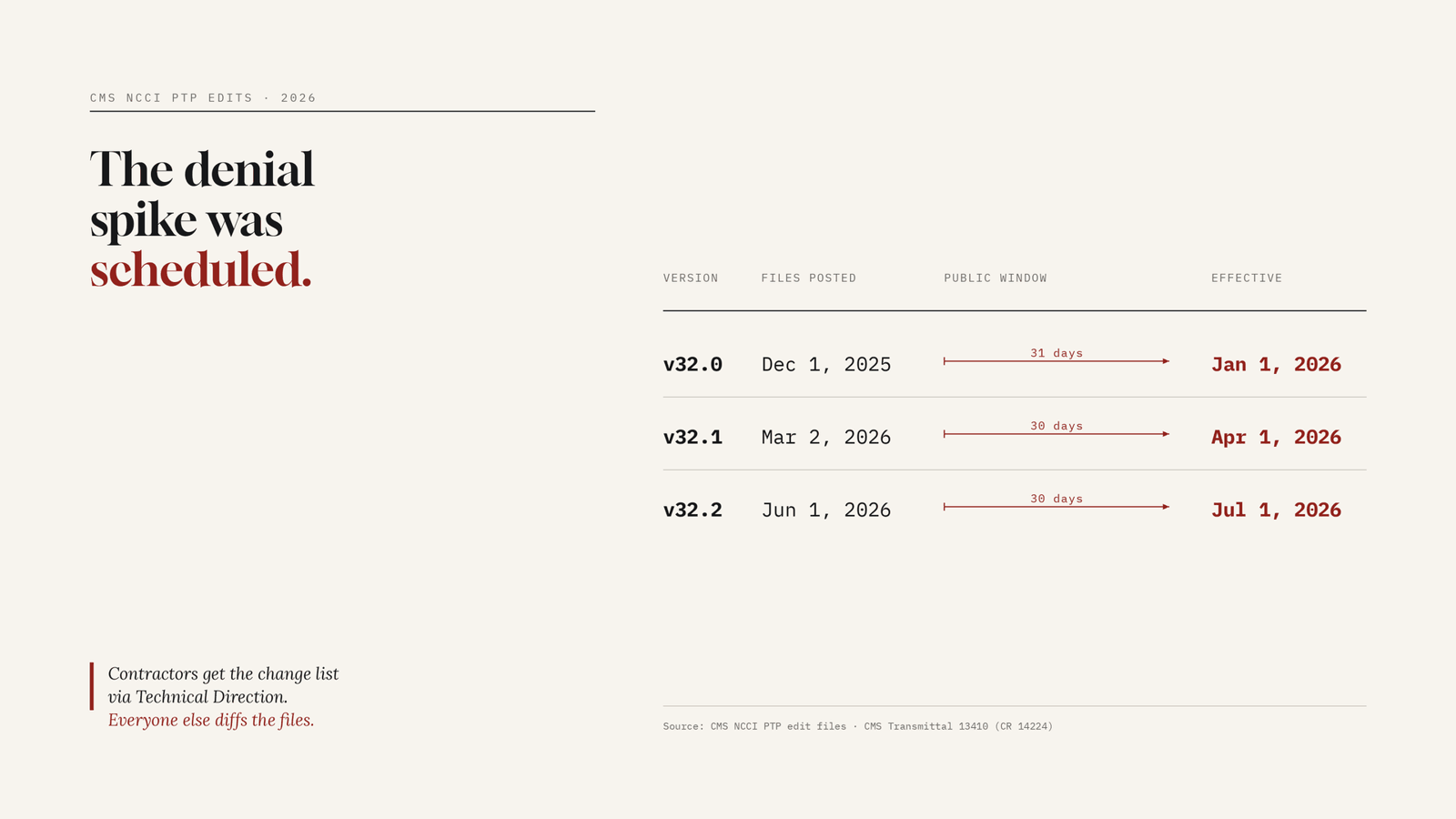
And it moves. CMS refreshes the PTP edits quarterly: January 1, April 1, July 1, October 1. Version 32.0 took effect January 1, 2026. Version 32.1 followed on April 1. Version 32.2 arrived July 1. Each update carries additions, deletions, and modifier indicator changes. A code pair that was payable on the last day of one quarter can be bundled on the first day of the next.
Where the denials come from
Most claim scrubbers work the same way: they check outbound claims against a loaded copy of the edit table. The scrubber is exactly as current as its last table load.
Here's the failure mode. The new edits take effect January 1. A scrubber still running the fourth-quarter table has no idea those edits exist, so it passes the affected claims as clean. The claims go out, sit in adjudication, and come back denied weeks later. By then the practice has performed and billed hundreds more encounters through the same stale table.
Then the blame lands. The denials arrive addressed to the coding team, the client asks what happened to quality, and someone starts pulling coder audit reports. But the coders did nothing differently. Same team, same claims, same habits. The table changed underneath them, on a schedule, and the scrubber kept certifying against the old one.
The changelog problem
This is the part that should bother you most.
Transmittal 13410 states that the detailed change lists for the update are provided to Medicare contractors separately, via Technical Direction. The entities that process and deny your claims received an itemized account of what changed.
The public got no equivalent. CMS posts the new quarterly files in full, and industry guidance says exactly what you'd expect it to say: download the new version and check for additions, revisions, and deletions yourself. The claims-processing side got a changelog. Your side got 2.4 million rows and an invitation to run the diff.
The window exists, if you use it
CMS does give you lead time. The version 32.0 files were posted around December 1, 2025, a month before they took effect. The April files were posted March 2. The July files were posted June 1. Every quarter, there's a roughly 30-day window in which the next table is public and the current one is still live.
An operation that takes denials seriously uses that window. Pull the new files the day they post. Diff them against the current table. Flag every affected code pair that appears in your clients' top billed combinations. Load the new table before the effective date, and re-scrub anything queued to go out after it. None of this is exotic. It's calendar discipline applied to a known, published, quarterly event.
An operation that doesn't do this finds out about version 32.0 the way most did: from the remittance advice.
Audit the table before the team
When bundling denials spike at the start of a quarter, the first question shouldn't be about coder performance. It should be about table versions. What edit table was the scrubber running on the effective date, and when was it updated?
If the answer is "sometime after the denials started," you've found your root cause, and it wasn't a person. It was a calendar. And it repeats every 90 days.
Sources: CMS Medicare NCCI Procedure-to-Procedure (PTP) Edits; CMS Transmittal 13410 / CR 14224, effective January 1, 2026; NAHRI, CMS quarterly NCCI edit file guidance.